The project arrived with its runway already spent.
It came late in its cycle, after repeated review had consumed most of the schedule. The requirement did not move with it: 54 store-specific documents, 16 variable fields in each, accurate.
Speed on its own would have been dangerous there. The question was how to make the standard executable under compression.
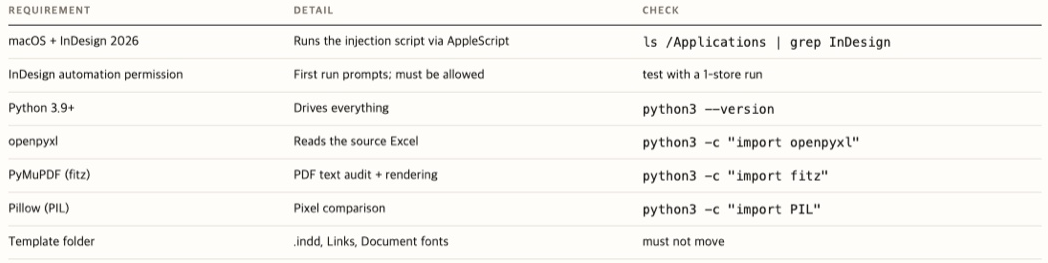
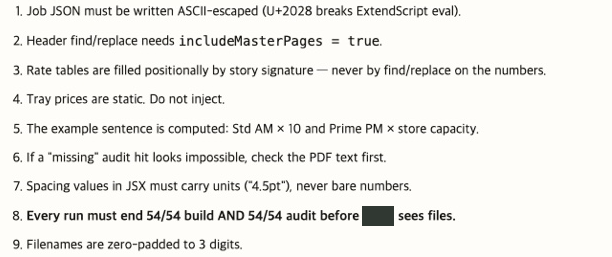
I marked the variable regions directly in the InDesign master with a named swatch, so the file itself became machine-readable and there was no separate mapping document to fall out of sync. A nine-step script applied the typographic rules — widow removal, overset checks, superscripts, spacing. Rate tables filled by structural position rather than by numeric find-and-replace, because duplicate values are ambiguous and a search cannot tell two identical numbers apart.
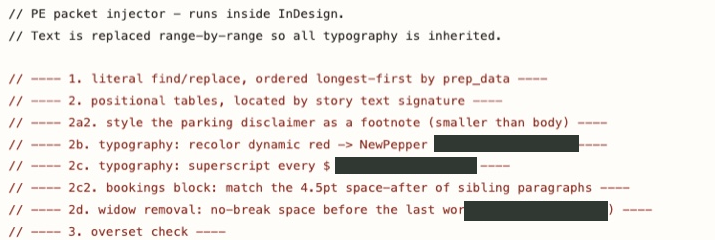
What got reverted is the evidence.
Nine reverts in three days.
The parking disclaimer moved from inline text to a dedicated row, broke as overset in 18 stores, and ended as a reduced footnote. Paragraph spacing went through two approaches before settling on an explicit 4.5-point value measured off the surrounding paragraphs.
Then the calculation logic flagged something I had not gone looking for: a printed example sentence in the source described a party larger than that store could actually seat. The automation was more correct than the document it was reproducing.

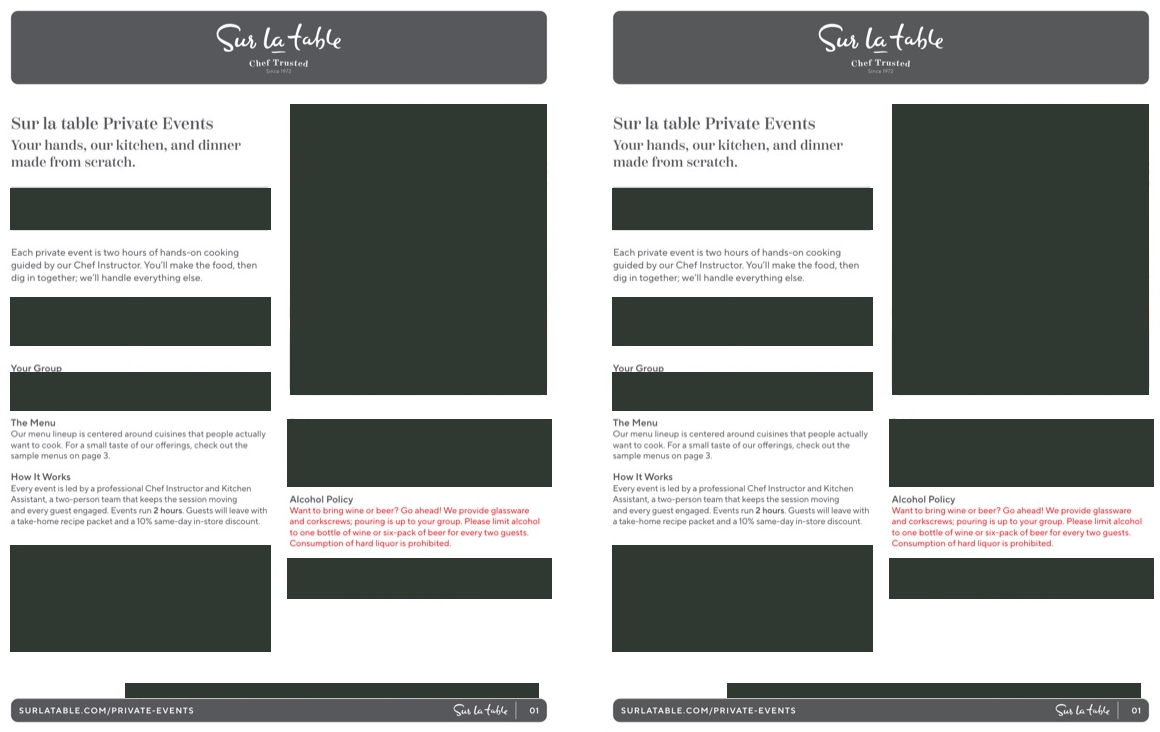
The run ends at a person.
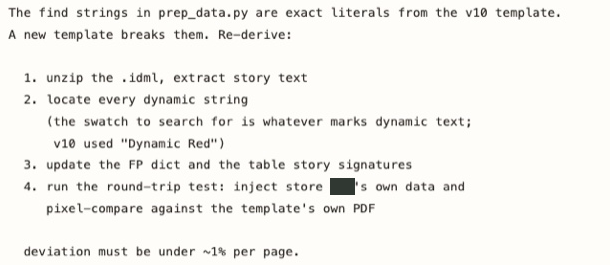
All 54 documents built and audited clean — 54 of 54, zero issues, under 0.7% round-trip pixel deviation across four deliberately worst-case stores, 30 to 60 seconds per store.
None of that is the definition of done. The rule is that a run must finish both passes before the files reach me at all, and then I spot-check and approve. Automated success earns the right to be reviewed; it does not replace the review.
The maintenance handoff carries nine non-negotiable guards, an escalation path, and a procedure for re-deriving the pipeline from scratch when a new template version breaks every find string in it.