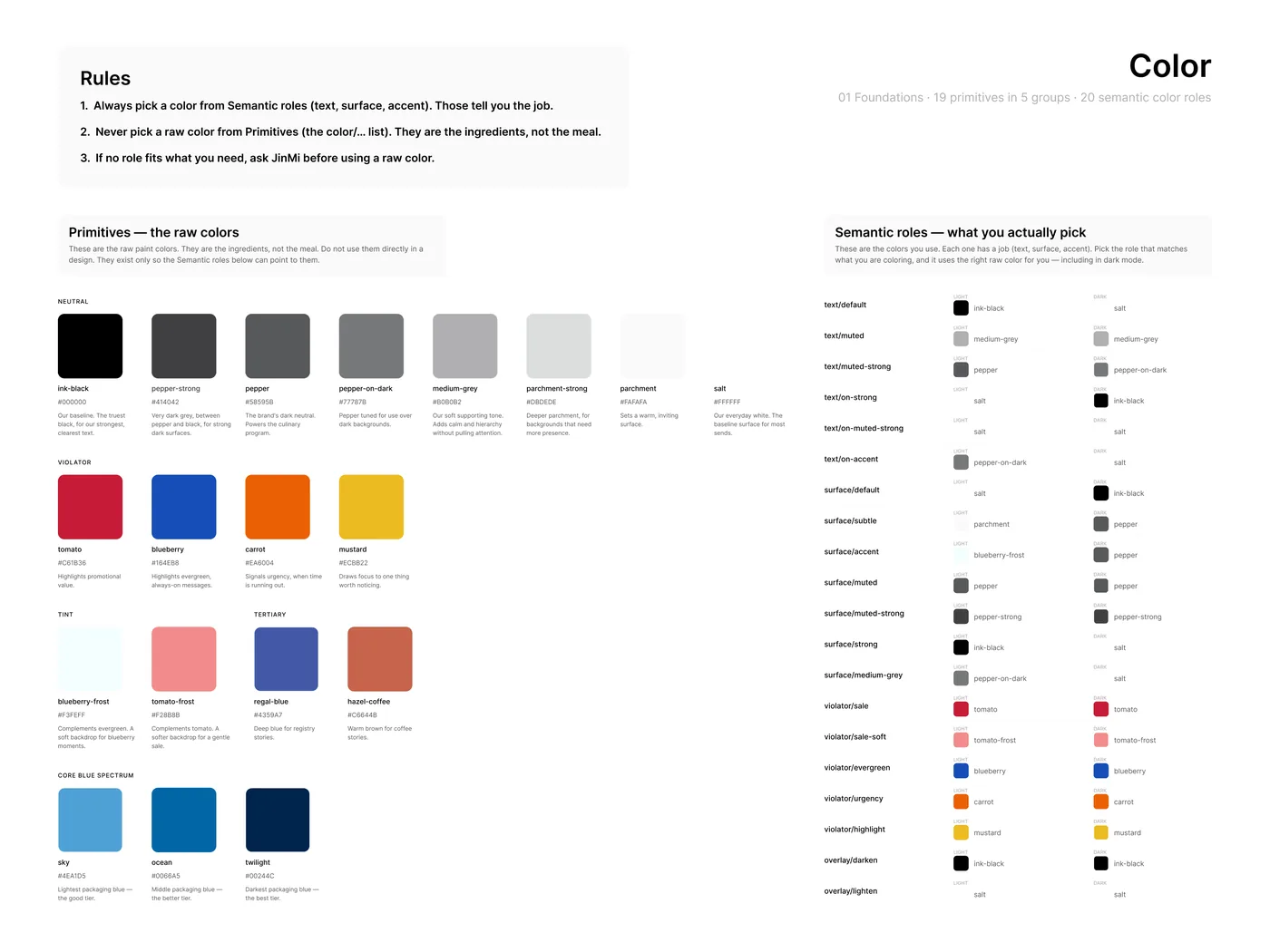
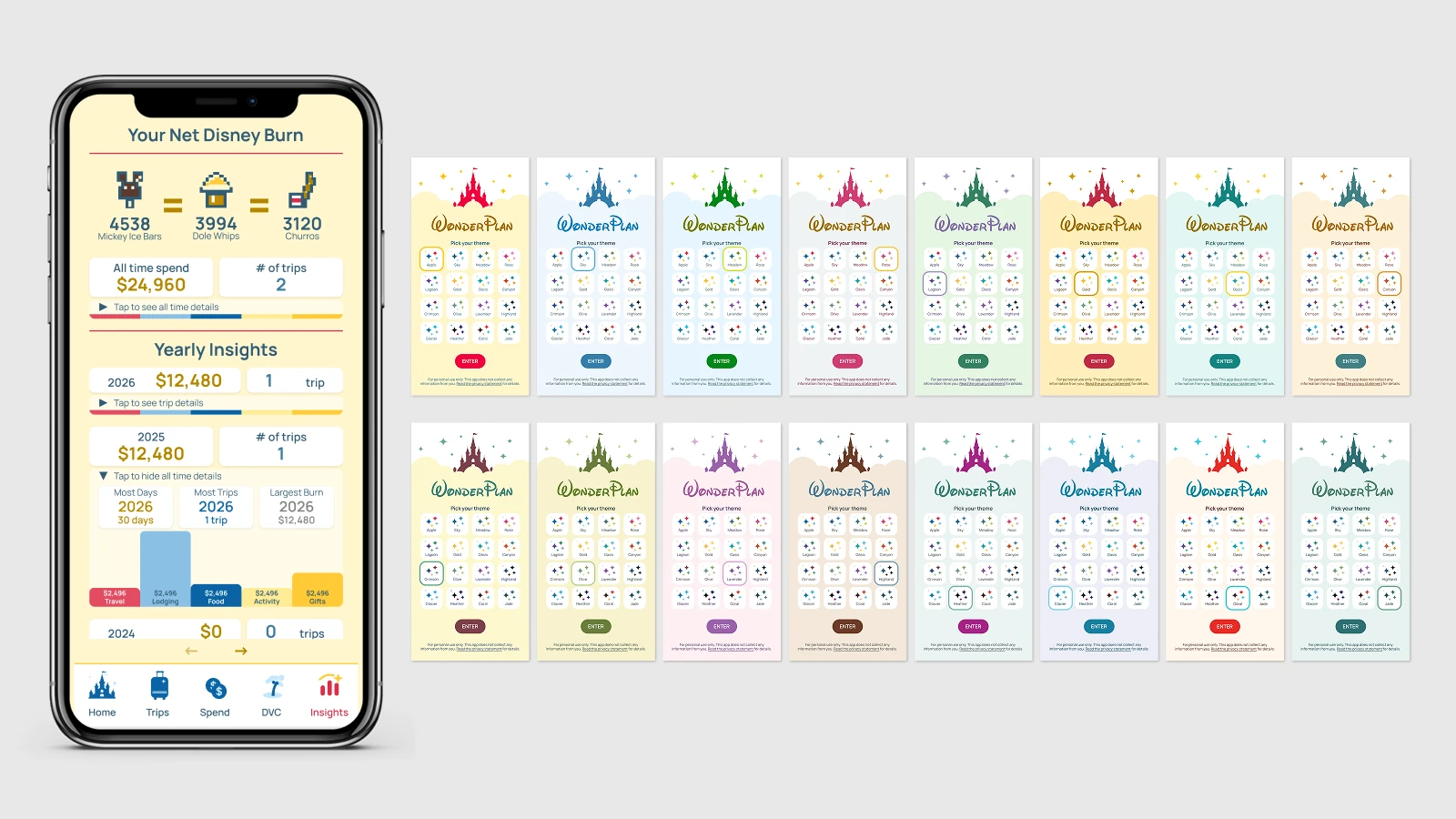
Packaging production had no repeatable process.
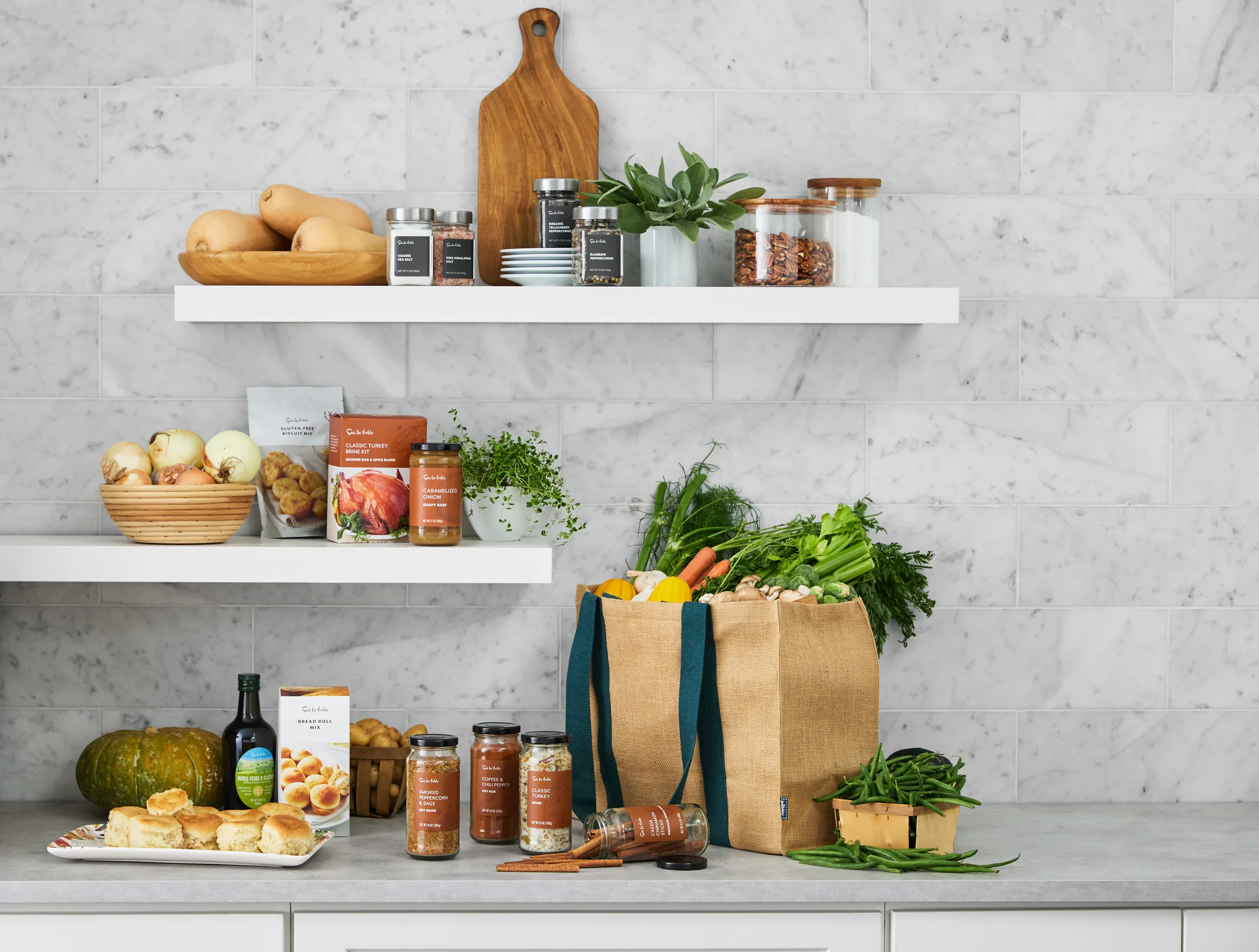
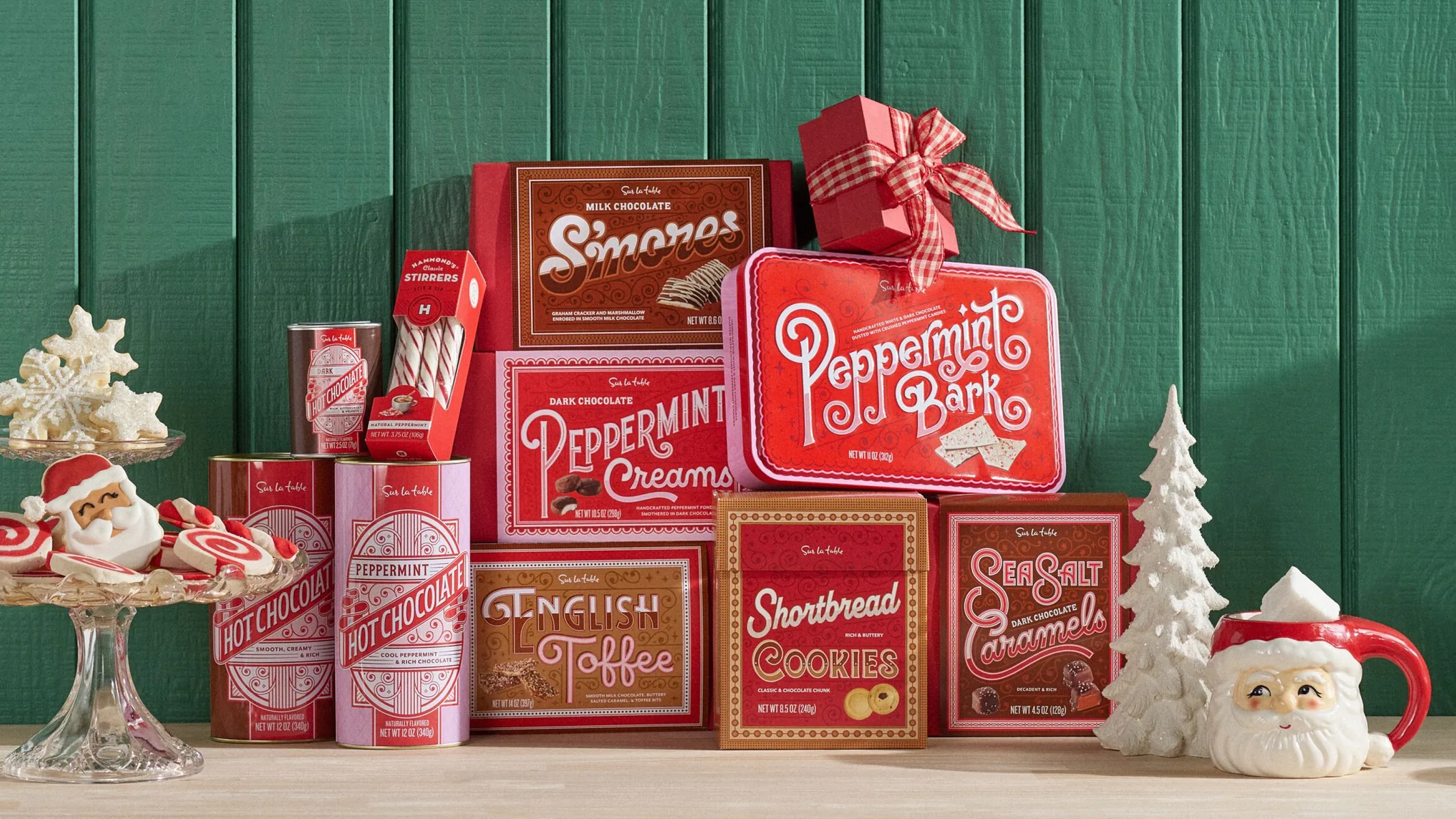
When I was hired, packaging ran on individual knowledge and repeated coordination. Hangtags alone were about 85% of packaging volume, and there was still no process anyone could hand to someone else.
I built one there first, because it was the largest and most repetitive part of the work. Once the steps were written down and the assets sat where people expected them, production became easier to assign, repeat, and hand off.
That was the proof of concept for everything after it. If you design the work correctly, you can scale execution without scaling headcount.
Silos were the actual problem.
Across the wider creative team, work lived in silos — signage, digital promotion, packaging, photo prep — each with fragmented ownership. Delivery was person-dependent. Culinary photography was a single point of failure: if one person was out, the work stopped.
Maker's Studio formed quietly through mid-2024, was announced in March 2025, and launched formally at the end of September 2025. The staging was deliberate. A mandate would have produced resistance; a team that was already delivering produced adoption instead.
At launch it was eight people — six full-time and two contract — across print, digital, packaging, photography, and production support.
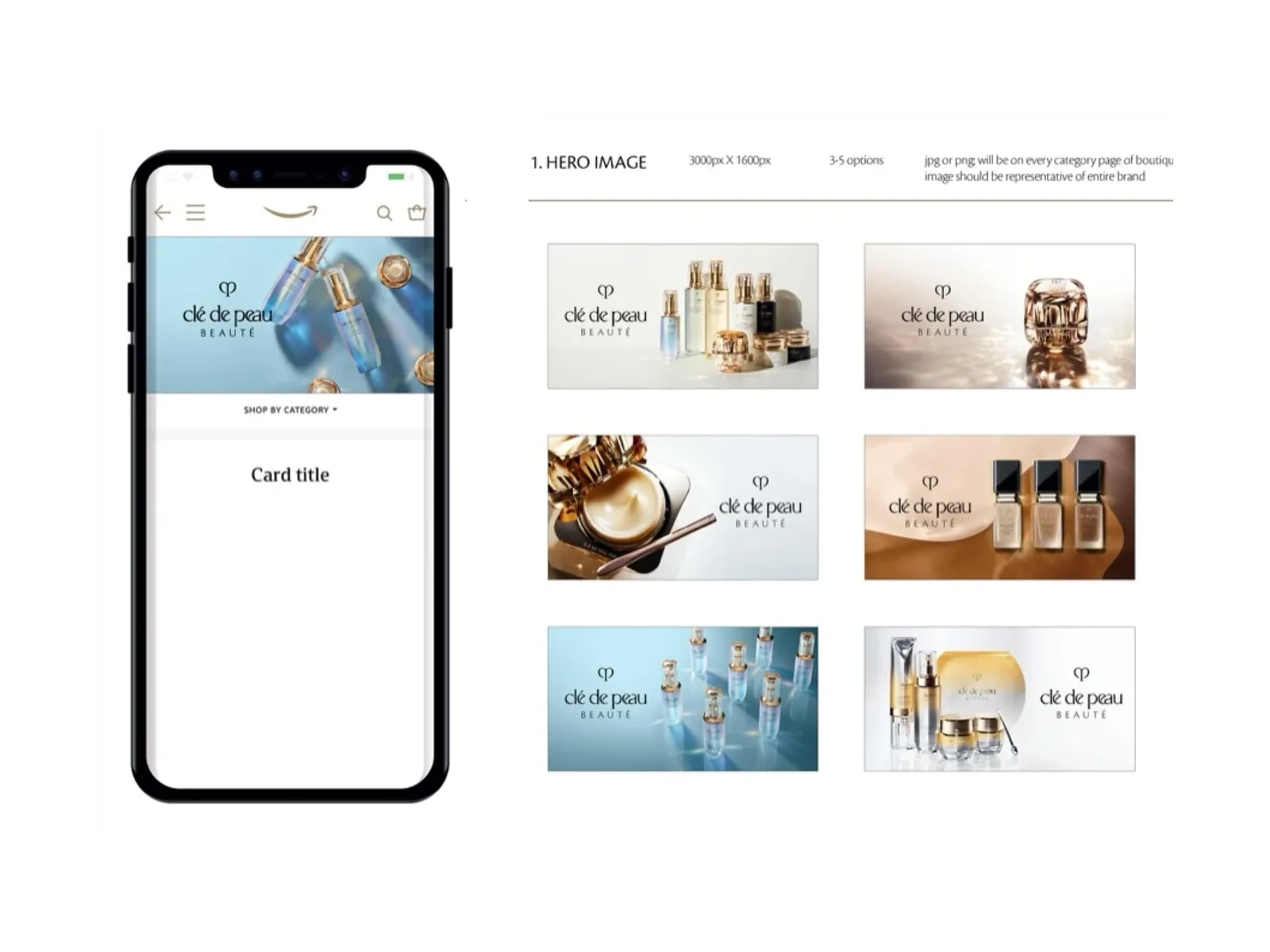
What they run is not one workflow. Creative production moves at four speeds, so the studio was organized around four of them: email daily, promotional and digital work weekly, signage and recurring production monthly — sign kits for more than fifty stores on that cycle — and packaging, store openings, and campaign launches as projects with their own planning horizons. Six channels sit across those cadences: Add-to-Web, signage, digital, packaging, culinary, and email, publishing roughly 500 assets a month across four of them.
I designed for flexible resourcing before I staffed for it.
Flexible resourcing was a design principle first and a staffing pattern second. That order is the point. I wanted to configure the team around each initiative rather than run everyone through every campaign.
Cross-training is how it got built. I trained a second person into the culinary photography workflow, then did the same in signage and digital production. The goal was never to make everyone interchangeable — specialist depth is what makes the work good. It was to remove the places where one absence stopped delivery.
By April 2026 I had four direct reports, each covering more than one lane, with creative influence across seventeen people as of August 2026.
Centralizing a team does not fix fragmented work.
Add-to-Web ran as six separate ticketed steps for what was, in practice, one piece of production. I collapsed it into one.
By the September 2025 baseline, task counts had fallen while average hours per task rose sharply — measured as 2025 year-to-date against full-year 2024. On a dashboard, that reads as a productivity problem. It is the opposite: fewer tickets by design, the same work arriving in more complete units.
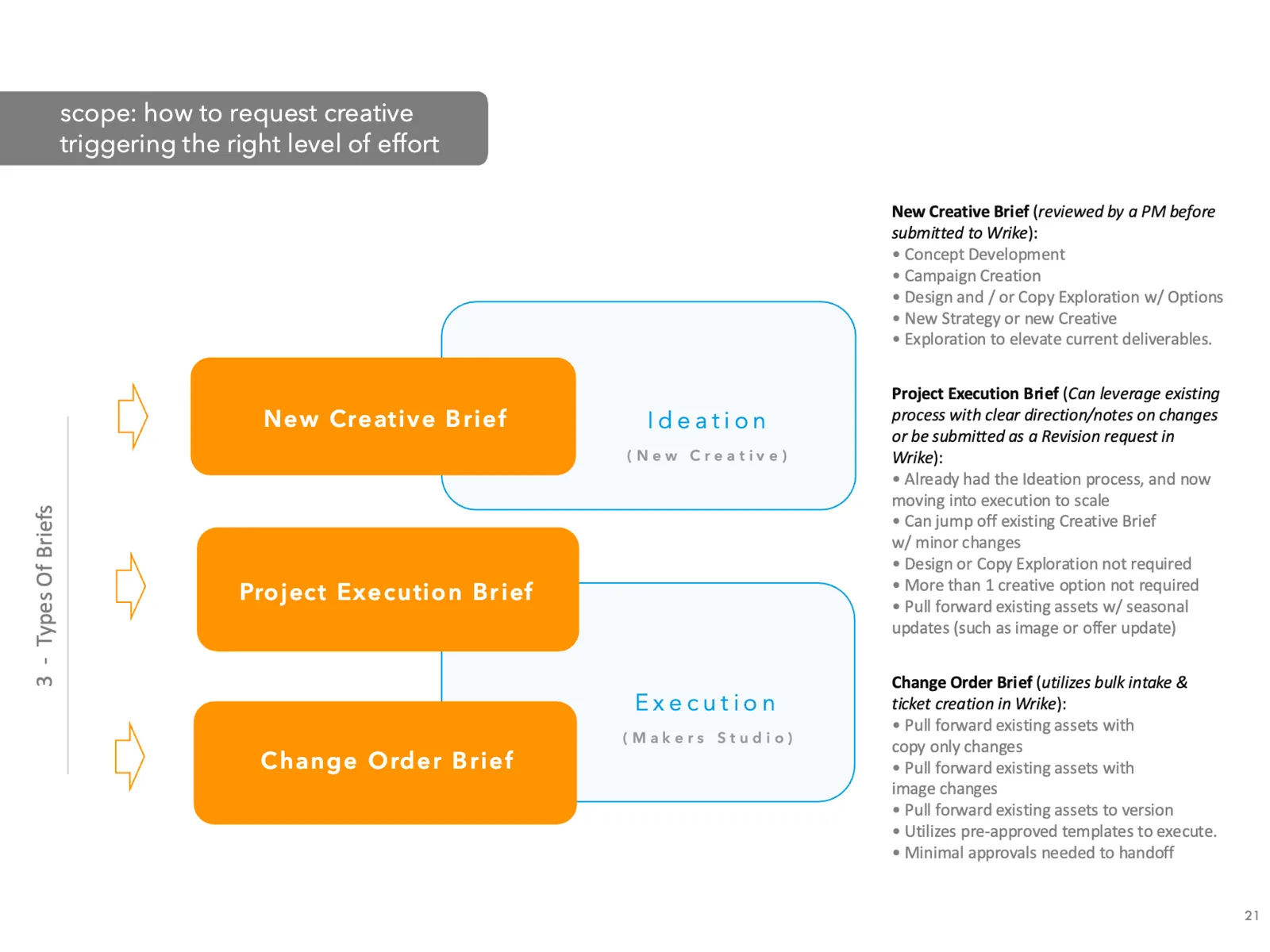
I rebuilt how work entered the studio at the same time. Three brief types now govern intake — New Creative, reviewed by a project manager before it reaches Wrike; Project Execution; and Change Order, which runs on pre-approved templates with minimal approvals — with phase gates handling everything downstream.
Creative operations can look productive when every resize, routing step, and revision becomes its own completed task. The queue fills. The team spends the day reassembling pieces that should have arrived together.
Execution moved to the team. Approval did not.
As the studio absorbed more, more of the production moved away from me. That was the intent. But execution autonomy and approval authority are different things, and I kept them apart deliberately.
The team gained skills, shared tooling, and ownership of the production flow. Creative accountability stayed where it was. Maker's Studio runs the execution layer across the cadences it supports — creative direction, homepage design, and certain signage zones belong to other teams. Cross-training itself was greenlit at sponsor level rather than declared by me.
What replaced my involvement was a sequence anyone could run: capacity, then priority, then assignment, then escalation, then delivery. Front-loaded workloads, volume caps, and bandwidth modeling decide what the team takes on before anyone starts negotiating deadlines.
Some manual checkpoints stayed manual on purpose. Scale did not mean removing people from the work. It meant being precise about where a person's decision was worth what it cost.
The reorganization was the real test.
In July 2026 the organization restructured. Output held through it, and web production was absorbed into the team's scope.
That is the evidence I trust most in this case. A studio that depends on its founder is a staffing arrangement; one that keeps delivering through a restructure, and takes on a new production surface while doing it, is something the organization can rely on.
The read from outside the team was similar. In a company AI forum in May 2026, a colleague described the studio's work as "instrumental in moving 54 July signs into ICR days ahead of schedule." That is one project, described in a public forum rather than in a review.
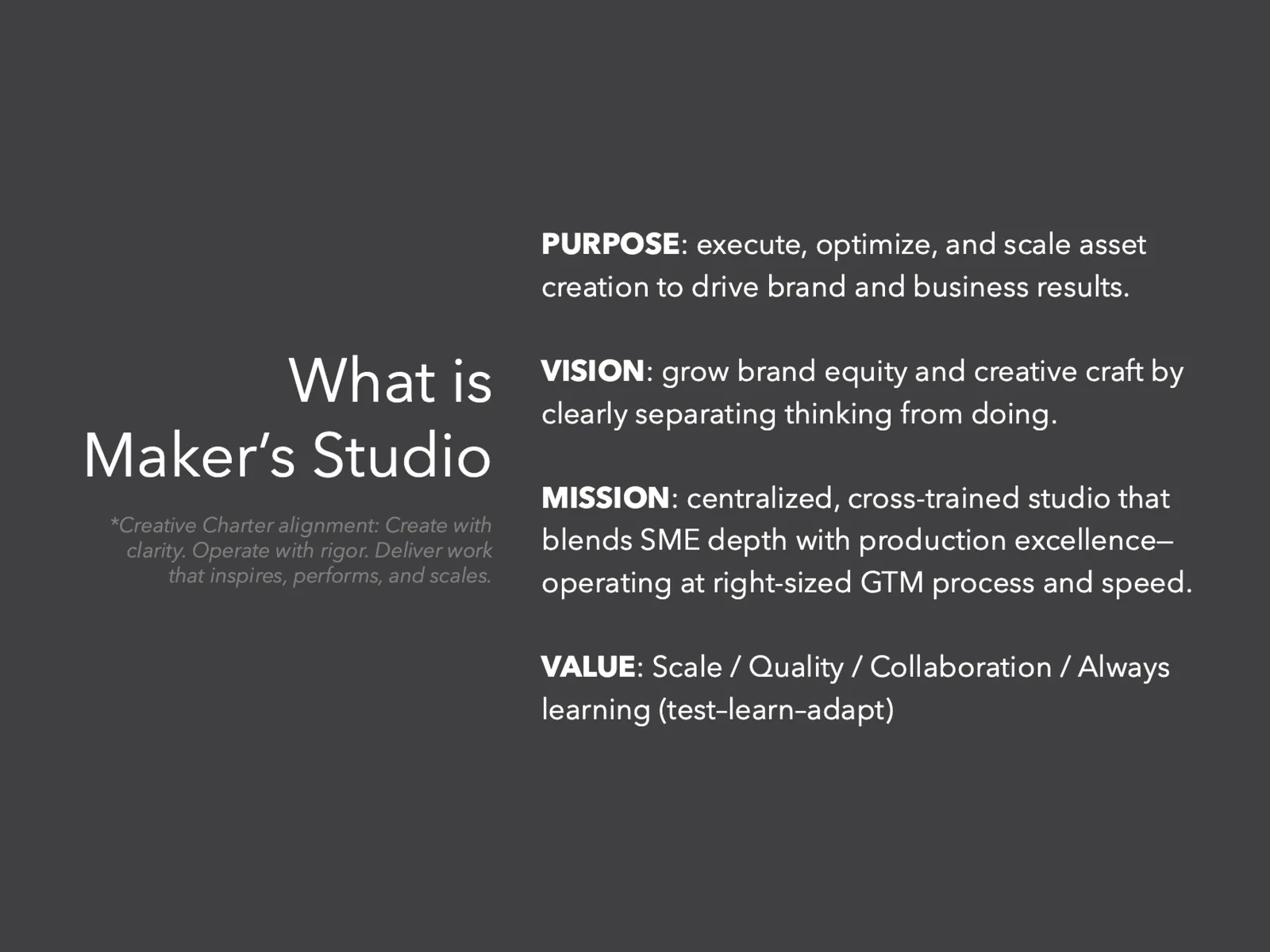
The charter still describes what it is for: execute, optimize, and scale asset creation — by separating thinking from doing.